
If you pay attention to the news, you’ve probably heard about fires caused by lithium batteries. A common scenario might go like this: Someone charged their phone and then it started to catch fire.
In its Status Report on High Energy Density Batteries Project published in February 2018, the U.S. Consumer Product Safety Commission reported that more than 25,000 overheating or fire incidents within a five-year period involved over 400 types of lithium battery-powered consumer products.
This statistic is only expected to rise as purchases of consumer products containing lithium batteries also continue to grow. As Steve Kerber, vice president and executive director of Underwriters Laboratory’s (UL) Fire Safety Research Institute (FSRI), told CNN, “The more batteries that surround us the more incidents we will see.”
Here’s the thing though: These aren’t just more fires. They’re fundamentally different fires that demand different approaches and different equipment. Because when lithium batteries go wrong—and they can go spectacularly wrong—they create a completely different beast than the fires we’re used to dealing with.
And, the sad part is most people have no clue what they’re dealing with when a lithium battery decides to fail catastrophically. So, understanding how a lithium battery fire is different from a normal fire isn’t just academic knowledge. It could literally save your life.
The Chemistry of a Lithium Battery Fire
Normal fires, the kind we’re familiar with, follow predictable patterns. You remove oxygen, heat, or fuel, and boom, fire’s out. It’s basic fire triangle stuff that firefighters have mastered for decades.
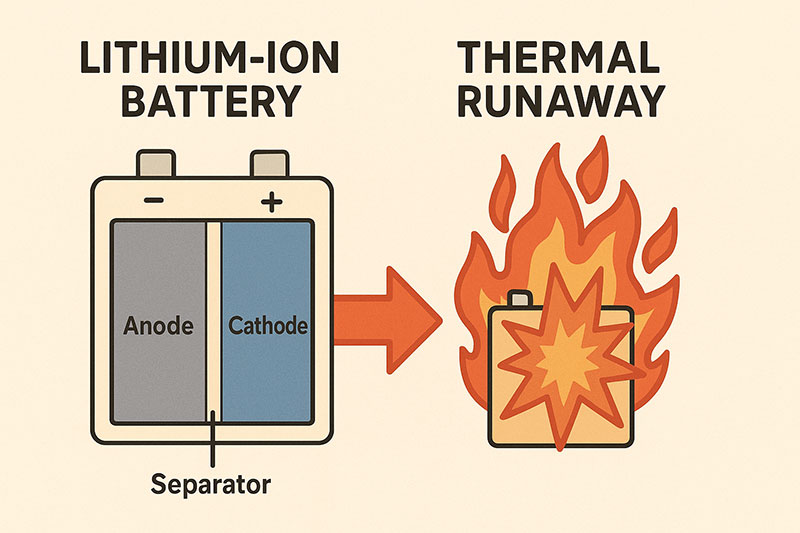
Thermal Runaway
Lithium battery fires basically laugh at the fire triangle. These batteries undergo what is known as “thermal runaway,” a chain reaction where the battery essentially generates its own heat, oxygen, and fuel. Think of it as a fire that feeds itself from the inside out.
“It’s a chemical reaction where the heat from one cell of the battery ignites the next cell,” Andrew Klock, senior manager of education and development at the National Fire Protection Association (NFPA), told CBS News. “If you think about it, it’s like a bunch of matchsticks and if you light one and they’re all touching each other, the next one will ignite.”
According to a study, this self-sustaining reaction can reach temperatures exceeding 1,000 degrees Celsius (compared to typical house fires that burn around 600 degrees).
Off-Gassing
Aside from starting a fire, thermal runaway also results in “off-gassing,” or when lithium batteries that are misused or abused release gases. Adam Barowy, a research engineer at the UL Fire Safety Research Institute, explains the phenomenon this way: “When you have a thermal runaway in a battery, it gets extremely hot. It breaks down the chemicals inside and can make flammable gases. If that gas doesn’t ignite, as soon as it comes out of the battery, it can build up and start to develop an explosion hazard.”
Toxic Smoke: The Silent Killer
The smoke from lithium battery fires isn’t just “bad smoke.” It’s a cocktail of toxic chemicals, such as hydrogen fluoride, carbon monoxide, and hydrogen chloride, which can seriously mess you up. When inhaled in significant amounts, these toxic fumes can be dangerous to your health.
They are especially hazardous when they accumulate quickly in a confined or enclosed space like a garage, especially since you can’t just hold your breath and run through this smoke like you might with a regular house fire. The particles are smaller, more toxic, and they stick around longer.
“It feels like you’re breathing — I don’t know if it’s like breathing acid or it’s like the air is so incredibly dry that it burns deep down into your lungs, so it hurts to swallow,” Haakon Faste told The New York Times. He lived around 25 miles from a battery-storage plant in Moss Landing that burned for days. The plant is the largest facility in the world that uses lithium-ion batteries to store energy. Aside from this, he recalled a metallic taste in the air days after the fire as well as experiencing symptoms like sore throat, headaches, and a bloody nose.
Because of this, fire fighters and emergency responders who are evacuating a building affected by lithium battery fire smoke must have full respiratory protection. Meanwhile, for regular folks, the consensus among professionals is clear: If you encounter a lithium battery fire, get out immediately and stay out. The toxic exposure risk simply isn’t worth it.
Water May Kill You—Rather Than Save You
When there’s a fire, most people might automatically think about splashing water to quench it. However, with lithium battery fires, that’s really not advisable, especially if you’re not a professional who has been trained on how to properly handle this scenario.
Water may put out a lithium battery fire, but you would need tons and tons of water to do so. Or, worse, water can cause these batteries to react more violently, potentially creating an explosion.
This is exactly what happened in Erie, Colorado, when a hybrid Jeep was seen emitting smoke. When fire fighters put water on it, the huge explosion that followed blew off the garage door 30 feet into the yard and almost hit a fire fighter’s head. Thankfully, he wore a helmet.
Instead of water, experts recommend the use of Class D fire extinguishers to combat lithium battery fires. Some departments have started using specialized foam or sand to smother these fires, but the effectiveness varies depending on the battery size and configuration.
Professional firefighters also typically use what’s called a defensive strategy. They focus on preventing spread to nearby materials rather than directly attacking the battery fire itself and instead just let the battery burn out.
The bottom line: When it comes to lithium battery fires, leave it to the professionals who have the right equipment and training.
Lithium Battery Fire’s Reignition Problem
Perhaps the most dangerous characteristic of lithium battery fires is their tendency to restart seemingly out of nowhere. This reignition is becoming a major headache for emergency responders.
This is caused by lithium salts in the battery. This substance is self-oxidizing, which means it can burn without oxygen so it can’t be starved out.
So, a battery that appears completely extinguished can suddenly flare back to life hours later as remaining cells in the pack reach thermal runaway temperatures. This reignition risk means that the normal “fire’s out, crisis over” mentality doesn’t apply.
Industry best practices now recommend monitoring lithium battery incidents for at least 24-48 hours after initial suppression. Some fire departments actually submerge electric vehicle batteries in specialized containers filled with water for days to prevent reignition—a practice that would seem bizarre for traditional fires.
In a nutshell: Lithium battery fires are easy to start but hard to put out.